Arrive without the list
In our imagined borough, the Saturday market begins before the first bag is opened. A trader straightens a crate. Someone carries a folded table through a gap between stalls. The public morning is being assembled from a hundred small tasks.
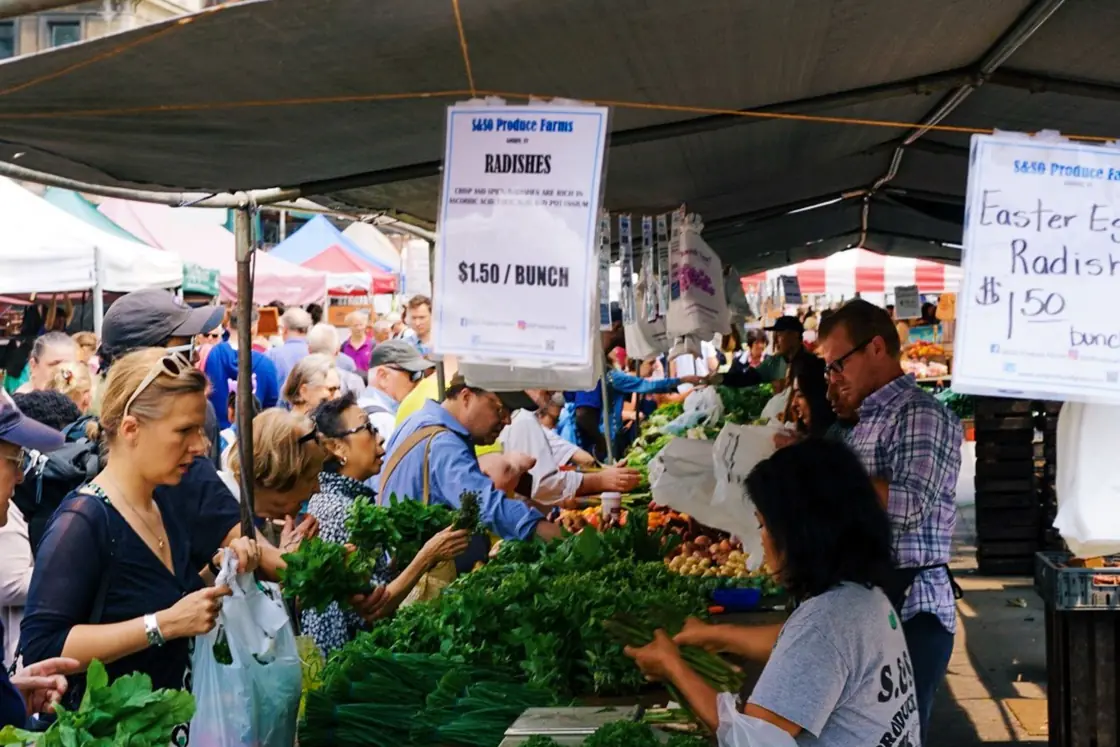
A market is easy to describe as a collection of things to buy. Spend a few minutes at its edge and another picture appears: people arranging a temporary room in the street. Canopies make a ceiling, tables become counters, and the paths between them become a kind of shared corridor.
For this walk, leave the shopping list in your pocket for the first circuit. Notice where the entrances are, how the stalls face one another and which corners invite people to stop. Looking does not require a purchase, though it does require leaving enough space for people doing their work.
Read the small arrangements
The arrangement of a stall tells a practical story. Heavy produce sits low. Delicate things are placed where they will not be brushed by a passing bag. A handwritten label answers the question that would otherwise be repeated all morning.
None of this needs to be romanticised. A market is a workplace, with lifting, waiting, packing and administration behind the visible display. The attractive crate is only one part of the day. Remembering that makes the scene more interesting, not less.
If you want to ask about a product, wait until the trader is free and make the question specific. Ask what you need to know about the actual item and how it is sold. Do not treat a busy counter as a performance arranged for visitors.
Take something away
After a circuit, return to the stall that caught your attention. It might be the one with the clearest labels rather than the brightest display. A useful detail can be as memorable as a beautiful one.
The walk can end with a small purchase or simply a better sense of how a familiar street changes on market day. Either way, the shopping list now sits inside a wider picture: the people, equipment and routines that make the morning possible.
This is an original illustrative essay about an imagined market, not a report from a named event. The accompanying stock photograph shows a separate real market and is used to illustrate the theme.
Original sample writing for The Borough Journal. No real reporting, interviews, quotations or named local businesses are represented.