
About Charter Recruitment
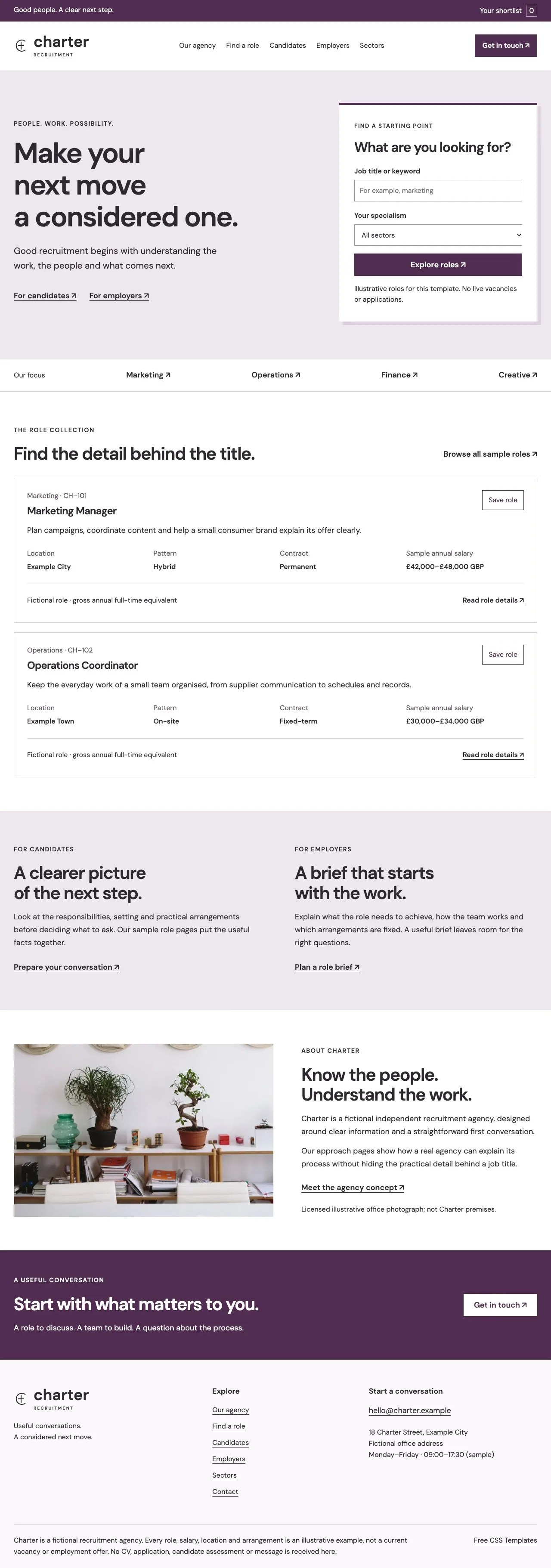
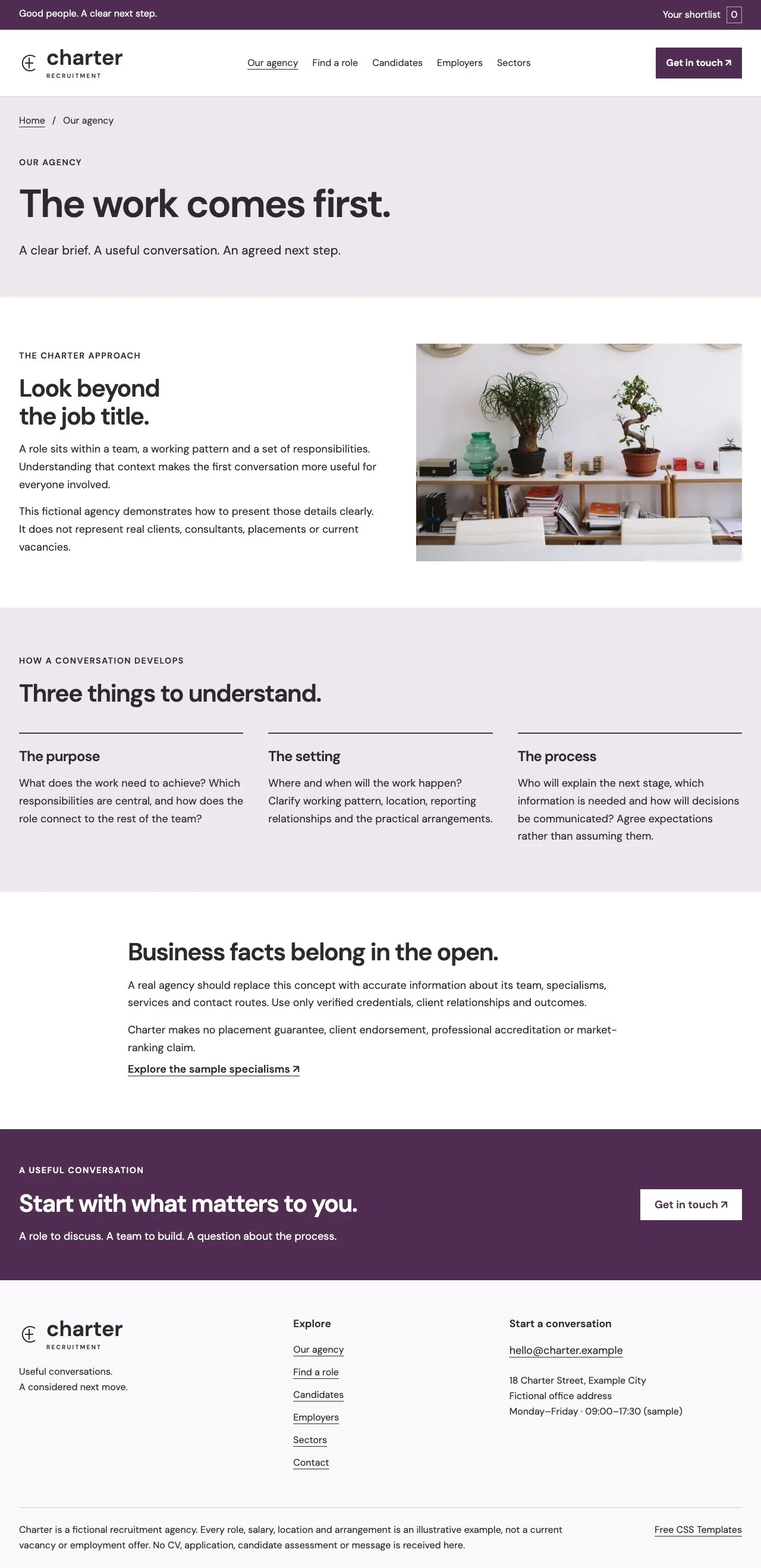
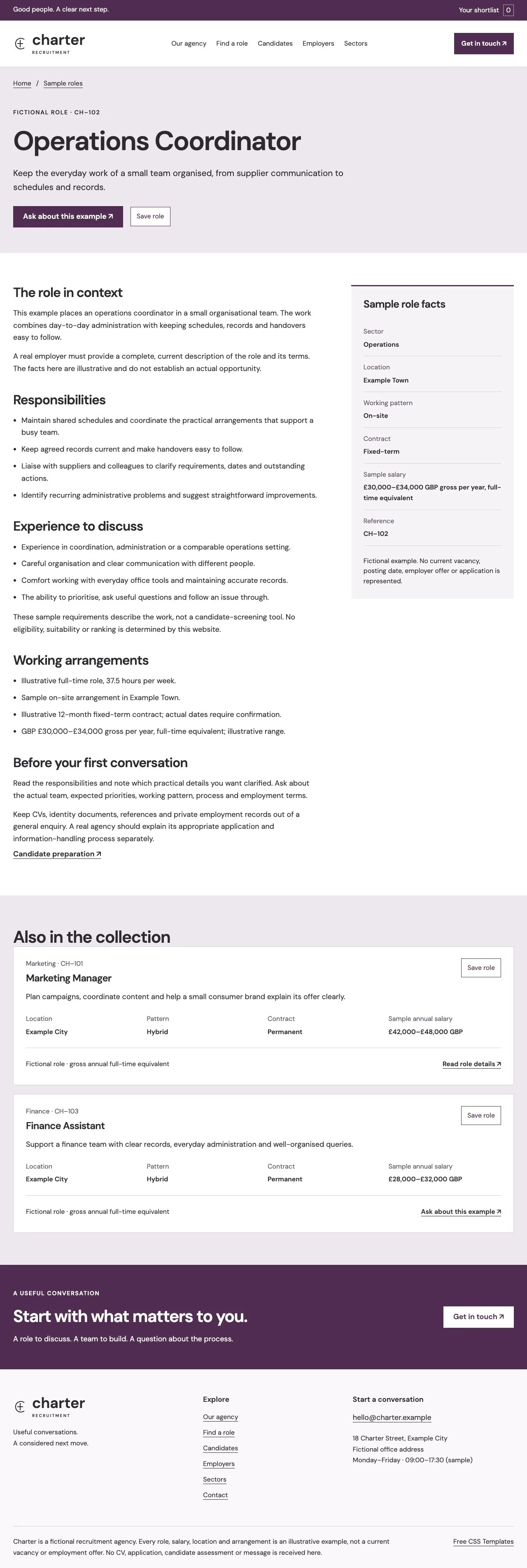
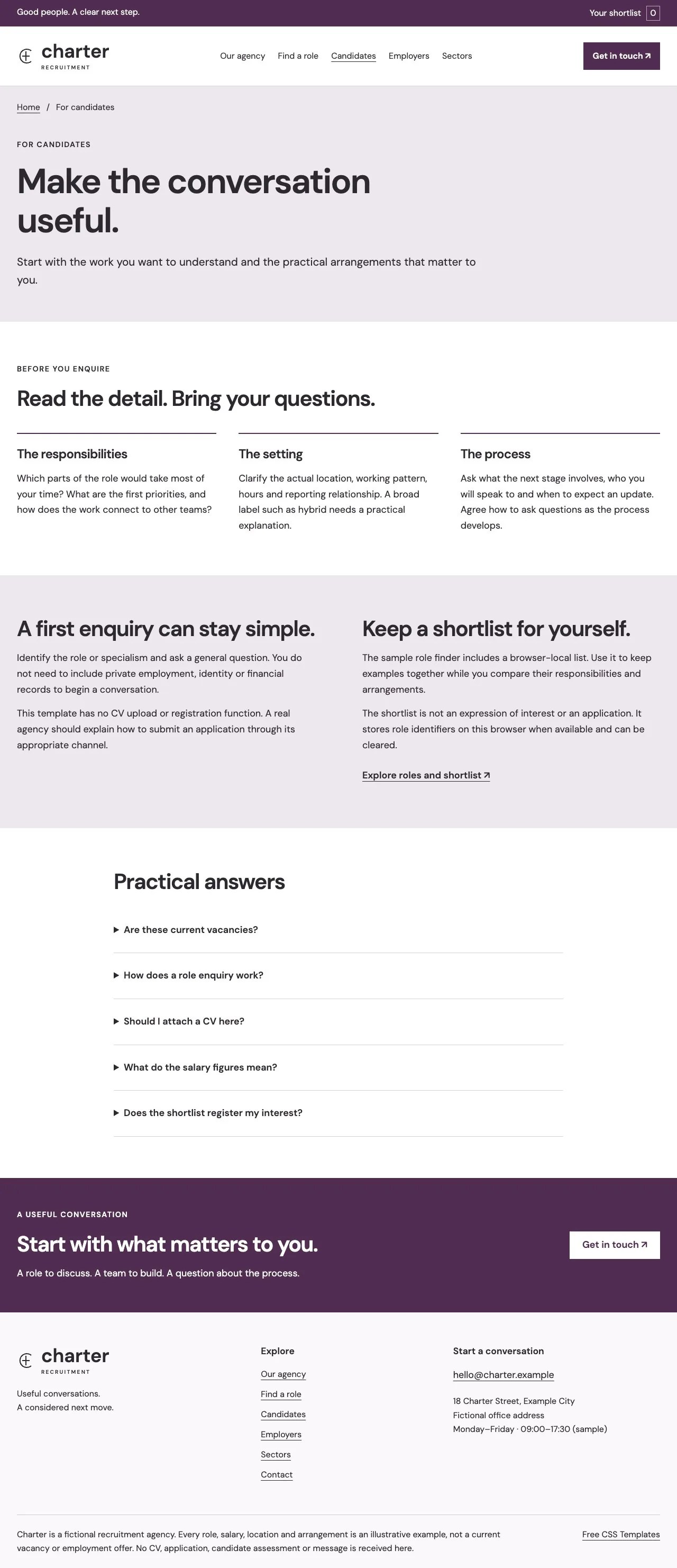
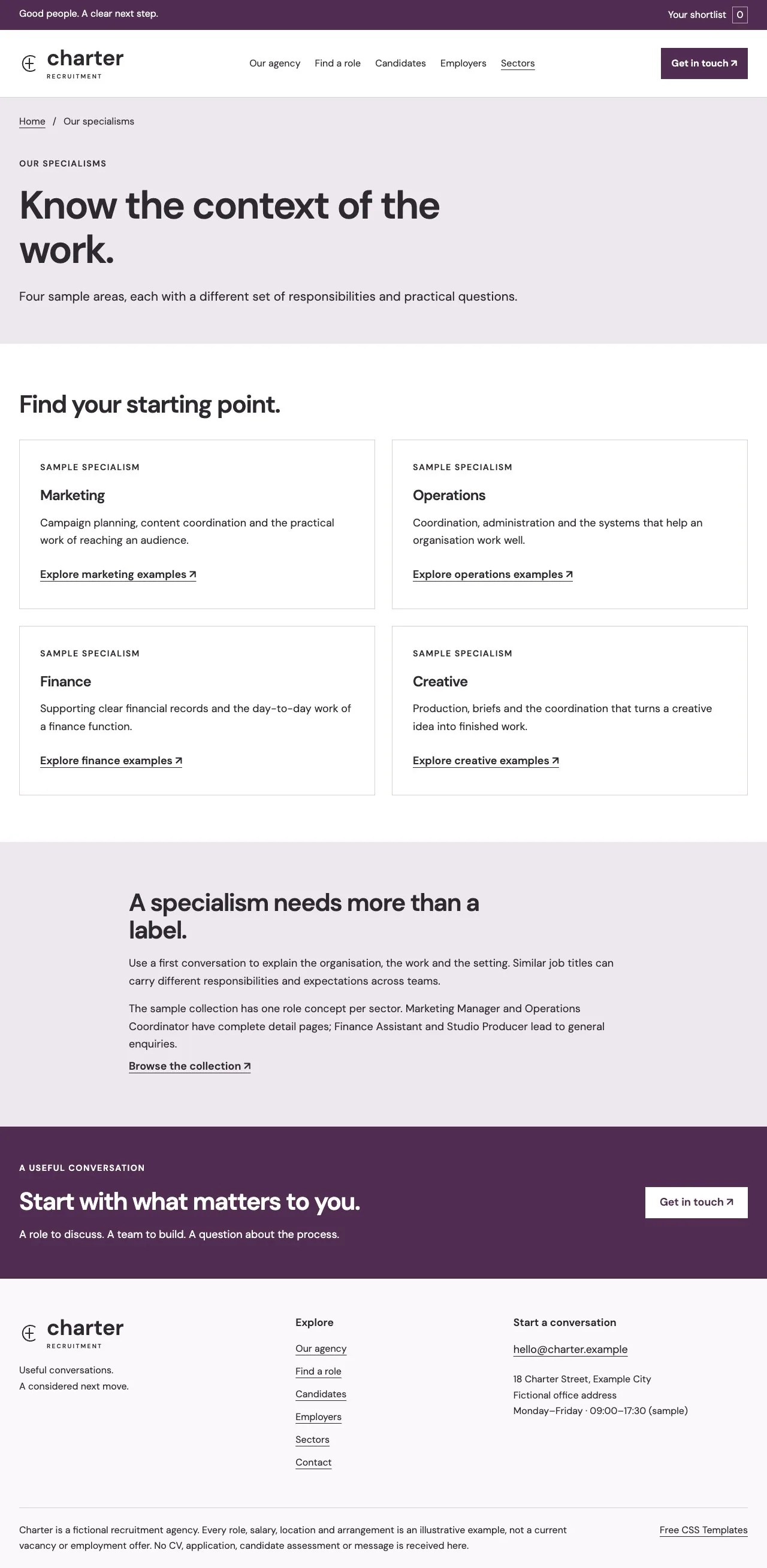
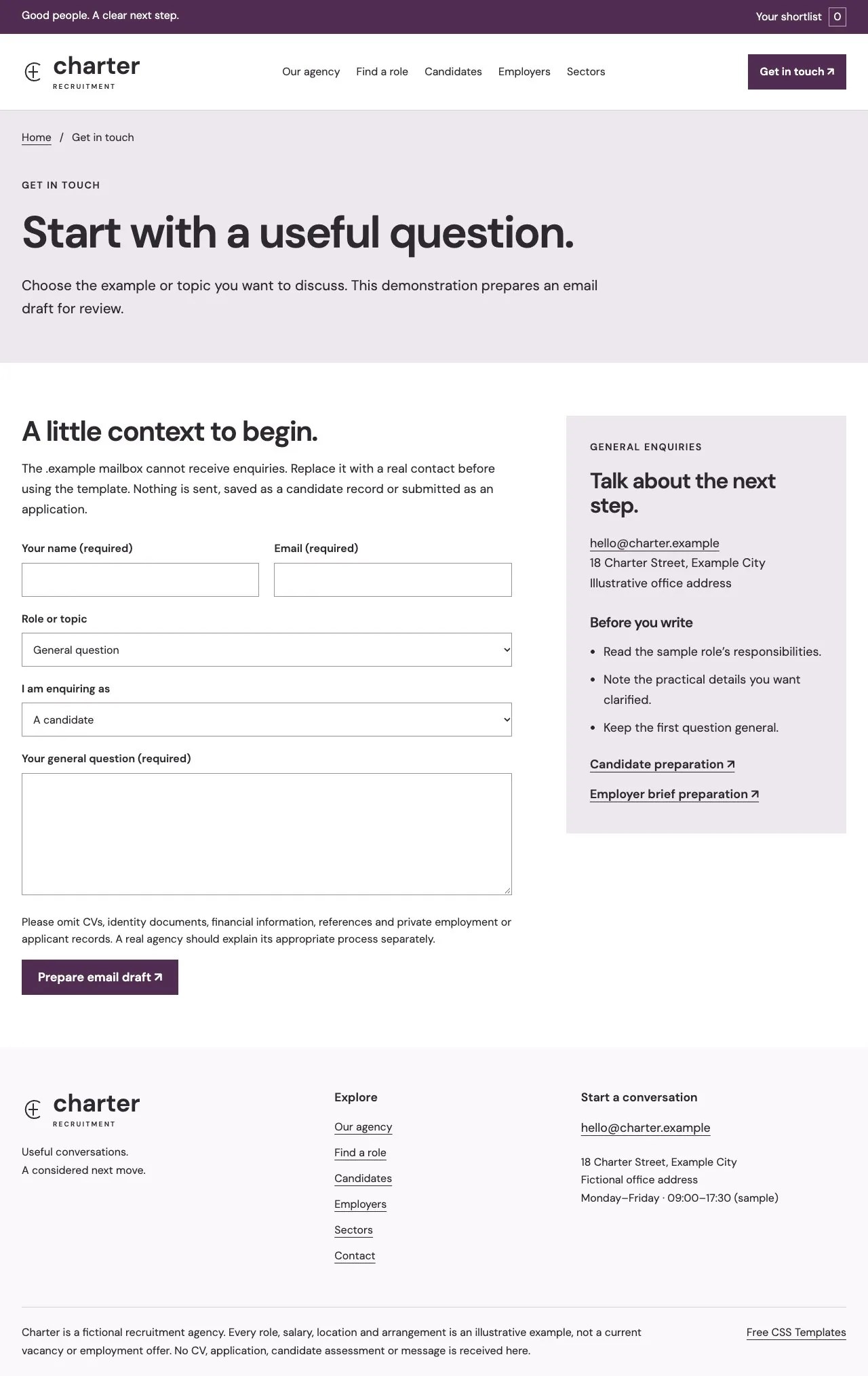
Charter Recruitment uses plum, pale lavender and white, confident Charter Sans typography and a practical agency layout. A prominent homepage job search opens a list-based role finder with sidebar filters, while full role pages pair readable responsibilities with a fact panel. Candidate and employer information have separate routes through the site.
Best suited to: Recruitment agencies and independent recruiters that need to explain their specialisms, publish authorised role information and offer clear candidate and employer contact routes.
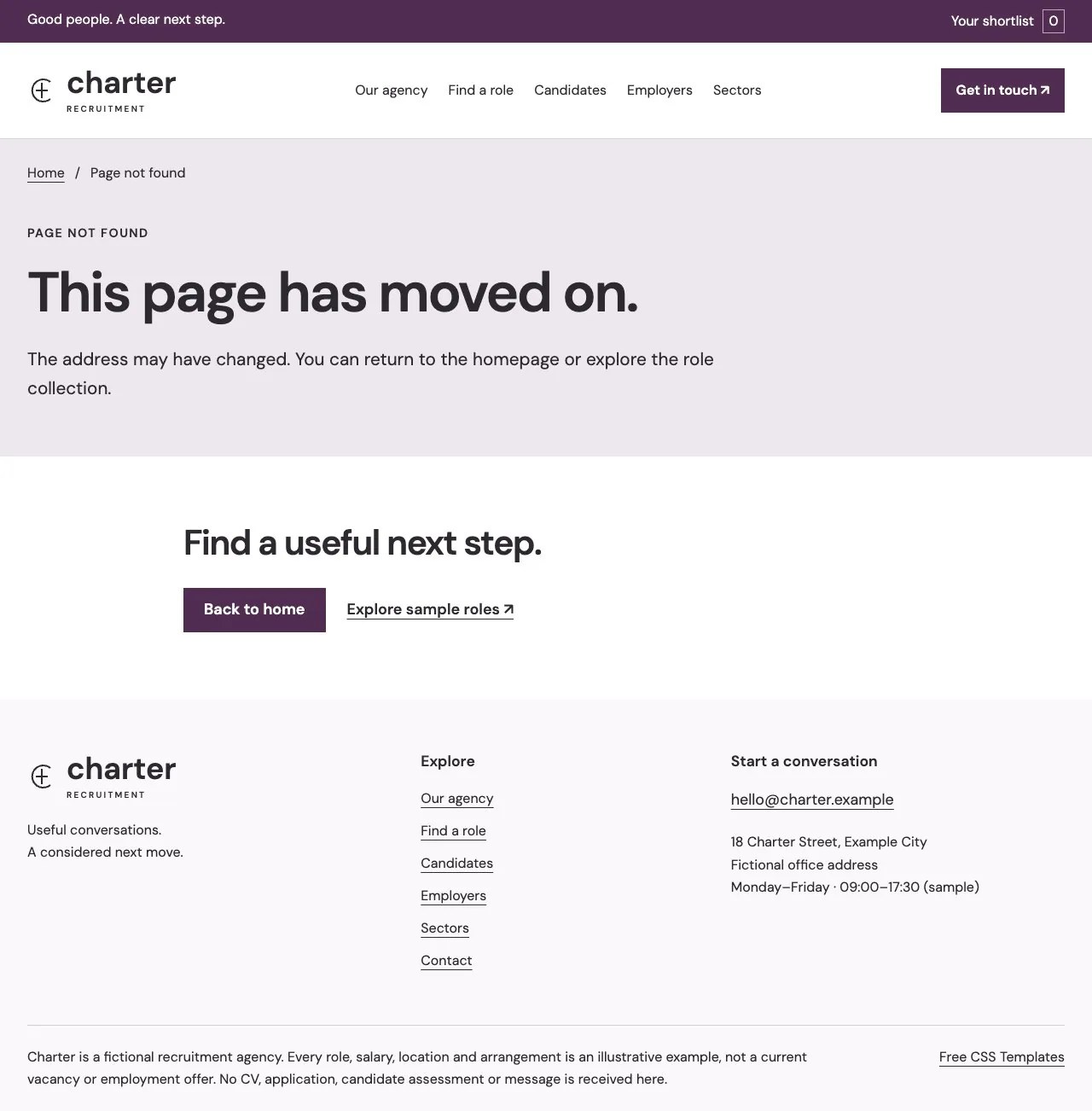
Desktop and mobile screenshots
Captured from version 1.0.0 on 30 October 2026. Open a screenshot to inspect the full page.




Choose your download
Both ZIPs contain the same 10-page design. Confirm your email to download. Newsletter emails are optional; no account or license key is needed.
| Edition | Included files and requirements |
|---|---|
| Plain HTML ZIP 0.37 MiB |
10 HTML pages, CSS, JavaScript, local assets, manifest, license notices and setup instructions. Requires: Any static host; no Node or build step required. |
| Standalone Astro source ZIP 0.41 MiB |
10 editable Astro pages, layouts/components, site data, styles/scripts, local assets, vendored kit, exact standalone lockfile and documentation. Requires: Node.js >=22.23.4 and npm >=9.6.5. No factory workspace, hosted service, account or API key required. |
What’s in the design
- The homepage search accepts a keyword and specialism, then opens the role collection with matching query values. Jobs combines keyword, sector, working pattern and contract filters with a result count, reset and empty state. Unknown select query values are ignored.
- Four explicitly fictional role concepts demonstrate marketing, operations, finance and creative work. Marketing Manager and Operations Coordinator have complete detail pages with responsibilities, experience to discuss, arrangements and preparation questions. Finance Assistant and Studio Producer lead to role-aware general enquiries.
- Role ordering is title A–Z or highest minimum salary first, with title as the salary tie-breaker. Every range is expressly illustrative gross GBP per year, full-time equivalent; these are not take-home estimates or market salary guidance.
- Save role controls maintain a browser-local shortlist of recognised role identifiers. Visitors can remove individual roles or clear the list. External storage changes update the display, and read/write failures explain when the current list may be temporary. No interest is registered with an agency.
- Candidate pages explain what to ask about responsibilities, setting and process. Employer pages outline a role brief covering purpose, essential experience, actual arrangements and an agreed recruitment scope. Four sector sections link into the filtered collection.
- Contact allows included role or general-topic preselection, validates required name/email/question, then displays an explicit email draft review link. Edits hide the obsolete draft. The ordinary direct email link remains available without JavaScript.
Verified page layouts
These 10 pages are included in both archives. Each link opens the live preview.
- Home
index.html - Our agency
agency.html - Sample roles
jobs.html - Marketing Manager
marketing-manager.html - Operations Coordinator
operations-coordinator.html - For candidates
candidates.html - For employers
employers.html - Sectors
sectors.html - Contact & role enquiry
contact.html - 404
404.html
How recruitment enquiries work
The form creates an encoded mailto draft for review in an email app. Nothing is sent, applied for, assessed, registered or stored as a candidate record by the website. Replace [email protected] before using the template.
The general enquiry has no CV or identity upload. It asks visitors to omit private employment, applicant, financial and identity records. A real agency must explain its appropriate application and information-handling process separately.
A role query accepts listed values only. The browser shortlist is independent of contact: it keeps role identifiers locally and does not transfer them into an agency system or synchronise across devices.
Set up the Astro edition
Extract the source ZIP and run these commands from its folder:
npm ci
npm run dev
npm run check
npm run build
The build produces a dist/ folder for static hosting. The source includes its shared template kit under vendor/template-kit, so it builds independently of our development workspace. Astro 7.4.4 and the Astro checker 0.9.12 are pinned; TypeScript 6.0.3 is the latest supported by that checker’s declared peer range.
Before you launch
- Choose HTML for direct file editing, or Astro for shared layouts and source-driven content.
- Replace the agency identity, contact routes, sectors and role records with accurate authorised facts. Keep salary basis, location, working pattern, contract and responsibilities explicit. Replace example terms and process information with the actual agency service scope.
- Edit src/roles.json for role facts and identifiers and src/site.ts for sectors and agency data. Keep cards, detail links, contact options and filter values aligned. Test combined filters, title and minimum-salary order, reset/empty states, local shortlist removal/clear/storage failures, allowed role queries, native validation and edited-draft invalidation.
- Replace imagery with licensed content. Keep responsive variants, intrinsic dimensions, alt text and ASSETS.md credits aligned.
- Set PUBLIC_SITE_URL to the real domain/folder URL with a trailing slash for canonical/social metadata, robots.txt and a 9-page sitemap. Leave PUBLIC_PREVIEW unset for production.
- Upload the entire HTML folder or Astro dist/. Configure unknown paths to return 404.html with HTTP 404. Test enquiries or configure a separately tested delivery route if direct sending is required.
A static agency website with no CV upload, candidate database, application submission, identity collection, screening, ranking, suitability decision, payroll, payment, salary-market advice, live vacancy feed or message-delivery backend.
License and assets
The original template code is released under the included MIT license. It permits personal and commercial use; retain the license notice when redistributing the code. Visible footer attribution is optional.
The illustrative office photograph is by Polina Zimmerman under the Pexels License; it does not show Charter premises. Charter Sans is a renamed DM Sans WOFF2 subset derivative, with the complete SIL OFL notice included. Original code, writing and logo are MIT. Pexels License. Full asset credits.
Release verification
The page inventory, screenshots and download manifests document the included layouts and assets. The HTML and independent Astro editions contain the same design and license notices. Customization requires its own accessibility, content and performance checks.
Version 1.0.0, reviewed 30 October 2026. Live preview. Plain HTML checksum. Standalone Astro source checksum. Charter Recruitment, its office, roles, salary figures, locations, contracts and working arrangements are fictional examples. No current vacancy, actual employer offer, posting recency, consultant or placement outcome is represented.


